For years now, we’ve included holiday letter with our Christmas card. We enjoy sharing with our friends the news of our world–our successes and struggles, life changes, political concerns, and reflections on scriptures that spoke to us that year. But this year’s letter is a little different!
These days, our family is substantially changed in form: the older two children are in college and grad school, and while in the past few years we’ve collaborated on our family holiday letter, they’re at a stage to write their own stories. I encourage you to reach out to these young adults to hear them!
A Quiet Life
Life is mostly pleasant in our mid-sized Midwestern town, and especially from the third floor of our 1902 American Four Square where I am writing this letter. From one window, I see the historic main street; from another, a great oak tree that makes me feel like I’m in a treehouse; and, from the third, our backyard, which is just starting to take shape.
This year, we planted a number of fruit bushes, but it’s likely that only a blackberry bush will survive. We had a decent crop of tomatoes, and our neighbor had an even better one and happily shared when we were in need. (Homebuying advice: look for neighbors who like gardening and who plant more than they can eat!) A few volunteer pumpkins popped up–and should have even more next year, as we hosted a jack-o-lantern carving party for the campus gay-straight alliance and tossed the seeds into a corner of the yard. About a dozen varieties of hens and chicks are flourishing in our rock garden, and the morning glories we planted to fill in the privacy fence have taken off, as expected.
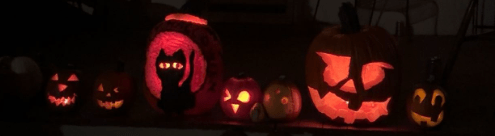
Above, jack-o-lanterns carved by our students at a chili-and-carving party at our house. Maybe next year we’ll carve the pumpkins that grow from the seeds of this year’s jack-o-lanterns!
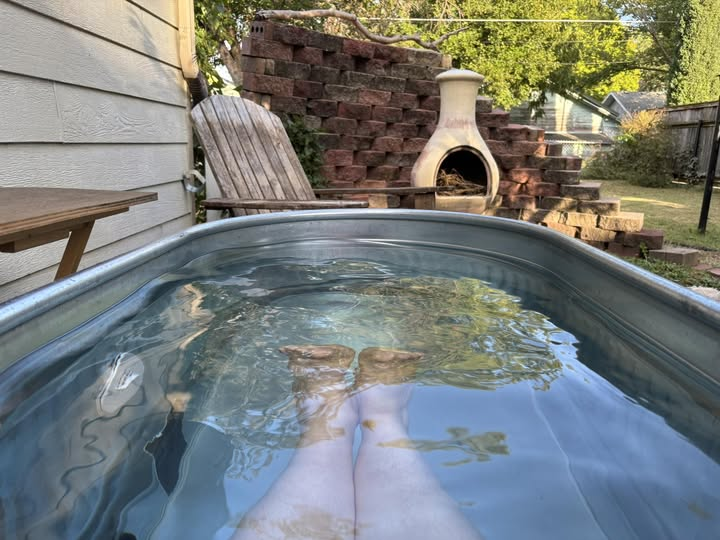
To this growing garden, we added a tank pool, which we kept in use until mid-October before we decided that the lower 70s were as cold as we could handle. We’re toying with ideas to heat the water. Advice is welcome!
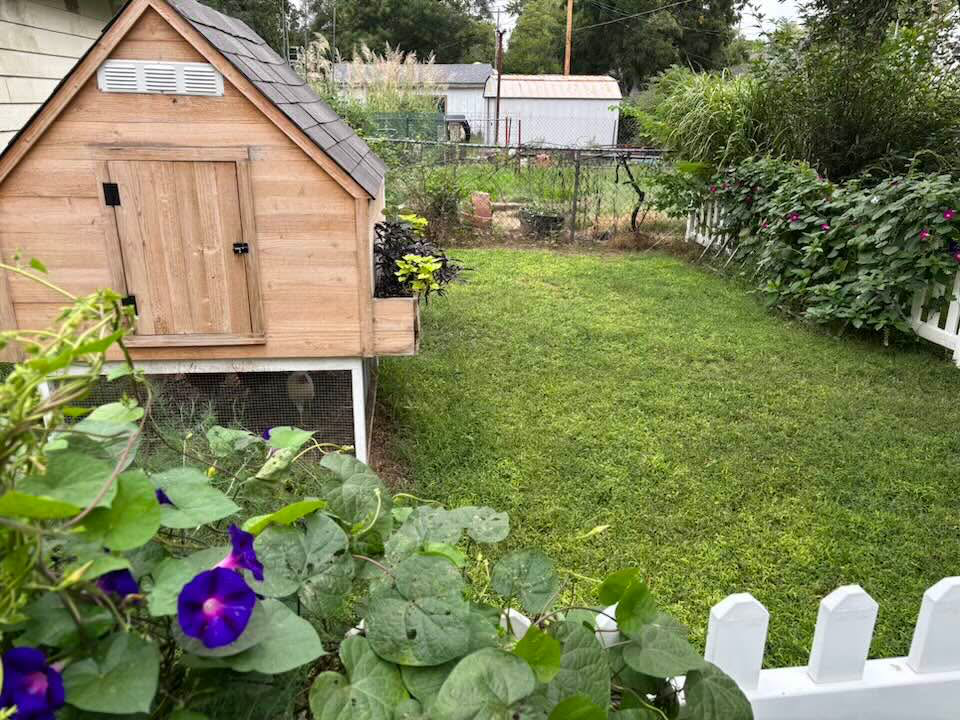
We also finally introduced chickens to our henhouse and now get 3 or 4 eggs–white, coppery-chocolate, pistachio, and blue–a day, which gives us enough to share with friends or deliver on our almost-daily walks to our neighborhood free pantry.
Living close to downtown means we can walk to some of our favorite spots: the new Mediterranean restaurant, a coffee shop or one of the town’s two bookstores (Red Fern, for new books, and Ad Astra, for used), and our pastry shop, Seraphim Bakery, which serves a delightful Scotch egg in an Art Deco setting. In the summer and fall, we can walk to the farmer’s market, but we love the fruit and vegetable stand so much that we have to bring the minivan to haul it all home. Downtown is also home to the Steifel Theater, where we sometimes see the city’s symphony. Walking the other direction brings us to a little private college, a beautiful campus of old brick buildings and a lovely pond with a fountain. From our back porch, we can hear the fans cheer at home football games.
We walk often, amping up our step count this year by completing K-State Extension’s Walk Kansas challenge, in which your team attempts to walk the distance of the state–423 miles–over two months. Our team, the Bad Knees Bears, included my siblings and brother-in-law and honored our grandmother, who passed away in May and who, when we were young, wore us out “tramping,” as she called it–taking long walks on country roads and hikes through the woods, despite her serious arthritis. We walk some local trails, but our daily walk is a neighborhood loop with Teddy and Lizzie, our dogs, that helps us get to know the neighbors and the neighborhood trees and flowers. (Hollyhocks are especially popular on our street, which has been a comfort since they were also part of my grandmother’s front porch garden during my childhood.)
We got new neighbors this summer, and it’s a joy to hear their three little children playing in the backyard, singing (“Wife is a highway, and I wanna wide it all night wong!” as the three-year-old sings), riding their trikes, and playing. I miss that stage of parenting: we had a summer of big birthdays–21, 18, and 13, so everyone “leveled up”–and even though we still have a lot of fun, it’s less silly. But, also, we see the reward for that earlier parenting when the youngest fixes his own lunch or the oldest changes their oil and the brake fluid solo.
Locally, we continue to work to reducing COVID infections and their harms. I’m trying to create a local Mask Bloc and share information about COVID and local transmission information and also provide respirators and COVID tests to those who want them. If you do or want to do that kind of work in your community, let’s collaborate! Or if you want to learn more about COVID, share your story, get support for your health, or work through your grief at the many losses from COVID, let me know.
School and Work
The older two kids are in grad school (master’s of arts in history) and undergraduate (social work and anthropology) an hour away, which is a nice distance in case of emergency but not so close that we step on each other. One is working with in a memory care facility, preparing food and serving people with dementia and also assisting a recently widowed professor in transitioning to this new stage of life by sorting and storing and toting her beloved’s things; both jobs are sacred work. The other child works in the registrar’s office, a job we remind them is incredibly cushy for a college student. The youngest child is in 8th grade, enjoying the little bit of time left before we expect a summer or maybe even after-school job. He built a new computer this year (and one last year, too) and enjoys biking, friendship, and game design, winning his teacher’s praise that his most recent game is the best she’s seen in the five years she’s been teaching the course.
Serving as a professor right now is hard; anxiety about decisions from the Department of Education and other federal agencies is high, as funding for important meaningful projects has ended, including a grant from KU Med that I was part of that worked to ameliorate inequities around COVID. We grieve with our colleagues and friends at the cruel and unnecessary cuts intended to undermine higher education.
But the work itself is encouraging. Many K-State students are the first in their families to go to college, and it’s a privilege to support them in this big step. The College of Technology and Aviation is a weird place for scholars in the Liberal Arts, but it’s also fun to learn from colleagues whose knowledge, assumptions, and experiences have been shaped in such different disciplines. Do they feel the same? Hard to say, so I keep a candy dish of Zotz outside my office to foster good will.
The scholarship part of the job remains satisfying, as the work contributes to a better understanding of issues that affect us all: COVID, health inequities, politics, religion, violence, and hate. Despite so much discouragement about academia, we need more, not fewer, people thinking about these topics, whether as researchers or readers and activists.
A Little Travel
We traveled to Kentucky in March to attend my grandfather’s funeral and burial, less than 10 miles from the rural homestead where he was born, near Somerset. It was a lovely funeral, planned in great detail by my grandfather, a lifelong carpenter who always paid attention to little things and cared about beauty. We took the opportunity to visit family in the area and got to enjoy a stay in the Cumberland Mountains
Above, a recording of The Stanley Brother’s “Farther Along,” performed by some cousins at my grandfather’s funeral
In mid-August, we headed again to the Buffalo River in Arkansas, to dip our toes into the first nationally protected river in the US. We recommend it heartily.
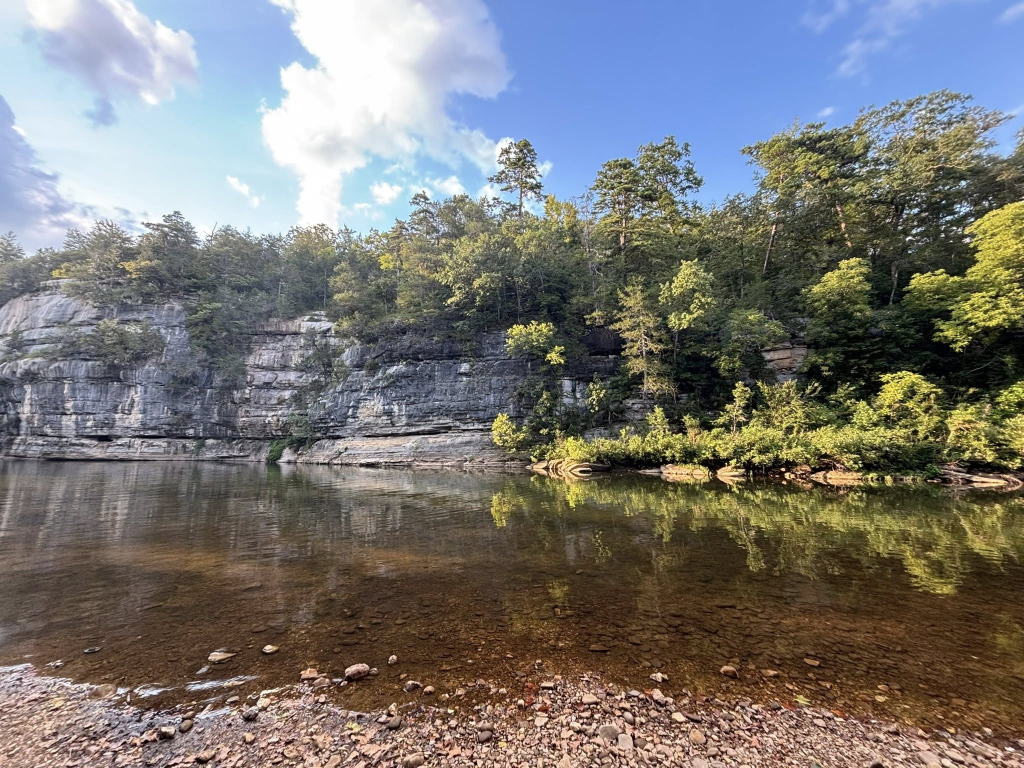
A favorite swimming hole along the Buffalo River.
And in October, the Rhetoric of Health and Medicine conference took us north to Minneapolis, a city we’d never visited before. Outside of the conference, we spent time at the Weisman Art Museum; the Bell Museum, a natural history museum with spectacular dioramas; and the Minneapolis Sculpture Garden.
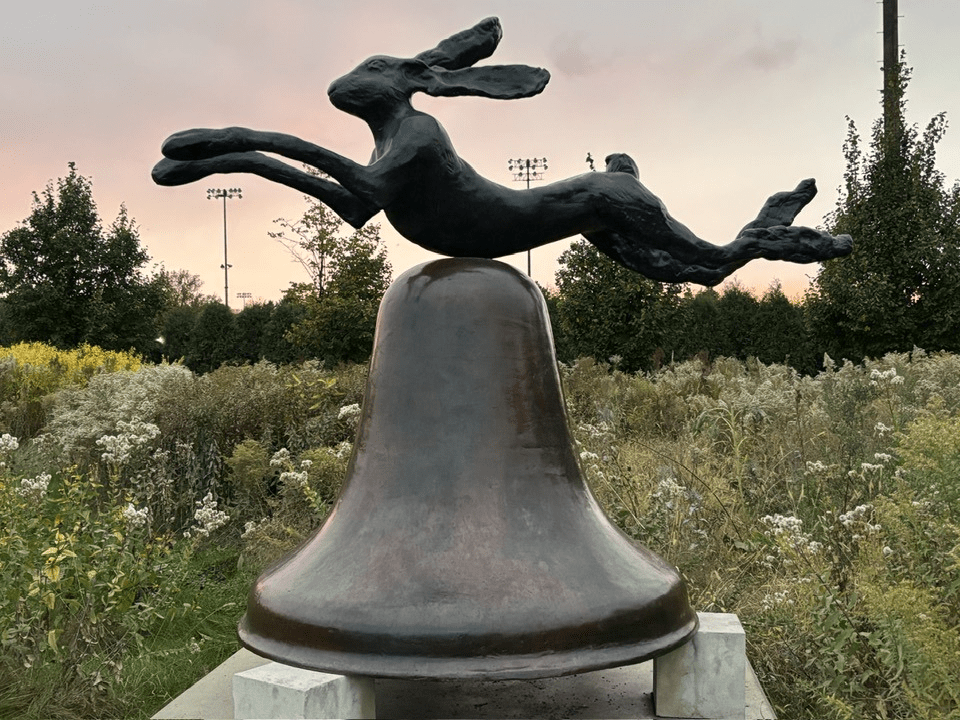
Hare on Bell on Portland Stone Piers at the Minneapolis Sculpture Garden
We love living in the Midwest in part because so many beautiful and diverse places are within a day’s drive. We’re lucky!
Our Goal for 2026: Seeking the Good of Others
Have you felt that people–maybe even yourself–have been a little, uh, ruder in recent years? More short-tempered and less thoughtful? The coarsening of our interactions isn’t just a downstream effect of callow political leadership. In his reflection on the fifth anniversary of the start of the COVID pandemic, science writer David Wallace-Wells identified a pattern of “survivor’s resentment”–anger that protecting each other imposed costs on us; we resent having had to do the work of caring. In backlash, we flaunt how much we’re not required to care for each other by cutting off others in traffic, declining to mask when we see others doing it, or generally prioritizing our preferences over others’ needs.
In this moment, when it feels like fellow drivers, colleagues, customers and customer service reps, students, parents, fellow shoppers at the grocery store, people I’m trying to share the sidewalk with, almost everyone on social media, and virtually all politicians are ruder, cruder, and more selfish, I’ve turned to the Apostle Paul, who was pretty skilled in helping people get along. (Paul and I have had a contentious relationship, but when I see him not as a theologian but as an organizer, my appreciation grows.) In 1 Corinthians 10, he writes the script of our internal monologue when we are experiencing survivor’s resentment:
“I have the right to do anything,” you say–but not everything is beneficial. “I have the right to do anything”–but not everything is constructive. No one should seek their own good, but the good of others.
Paul understands the temptation to shout “My rights!” and “I’ve already done my share!” and “It’s not fair!” But exercising our right can include declining our preferences when they make life harder for others. Paul directs us to seek the good of others, not advantage over them. This is even more the case when we are more mature, safer, or stronger than them and thus can easier relent of our desires than they can of theirs. Or, as Paul says in Romans 15:
We who are strong ought to bear with the failings of the weak and not to please ourselves.
These words are encouraging because they point me toward actions that reduce my anger and others’ refusal to care. Can I bear with an entitled student? An employee doing a lackadaisical job? Someone being an asshole on the internet? Sure, I have the right to complain, to assign an F or try to get them fired or cuss them out. But if I take Paul’s advice and seek their good, the situation almost always changes. I’m in problem-solving mode rather than rights-exercising mode, and I’m less angry, and that makes the whole encounter less angry.
This is not a cure-all–Our problems are big and rooted in an ableism that runs across the political spectrum and takes forms both rude and polite–but it is one strategy. We would love to hear yours as we struggle together for a kinder, more just world.
With love, on behalf of the larger B-F family,
Rebecca
PS. Want to hear a beautiful song? Listen to Guy Clark’s “Stuff that Works.” And share with us your own “Stuff that works, stuff that holds up/The kind of stuff you don’t hang on a wall/Stuff that’s real, stuff you feel/The kind of stuff you reach for when you fall.” We would be honored to hear about what you hold dear.
 —
—

 Family Foxhole